Tuesday, 28 August 2012

Basics of Buying Watches: Waterproof and Water-Resistant

via: flickr.com/guysie
Some people have asked me what is the difference between a "waterproof" watch and a "water-resistant" one.  Truth to be told, there is actually little difference despite what others may claim.  Waterproof was initially coined to describe a watch that prevented water from penetrating its casing under normal everyday usage conditions.

However, since the late 1960s, the term "waterproof" was put to an end by various government organisations, such as the US Federal Trade Commission.  The reason for this was that the word waterproof was found to be misleading, as in the products that were labeled and advertised as waterproof were not actually 100% well, waterproof.  That is to say, the seals of watch casings meant for keeping out water were not entirely impermeable.  Furthermore, the effectiveness of the seals would diminish over time through age, wear and tear as well as exposure to chemicals.

Therefore, many watches today are labeled as water-resistant and will specify its depth rating in meters or feet.  This practice has been issued by the International Organization for Standardization, which many countries have adopted, thus forbidding the term "waterproof" to be used with watches.

However, just because watches are water-resistant to depths of over a hundred meters does not mean you should wear it in the bath or shower.  Water resistance means it can prevent the entry of water under the depth pressure it was tested in, under laboratory conditions.  Water-resistance does not factor in high water temperatures (higher than body temperature), since most of these watches were created for and tested in  cold water, hence the heat will severely damage the seals of the watch.  Additionally, sharp changes in water pressure from activities such as swimming on the surface, may adversely affect your watch too.  Moreover, sudden changes in water temperature, going from hot to cold water or vice-versa, may cause the rubber seals to contract, allowing for water to seep in. Finally, soap can also damage your watch as it accumulates in the small joints and can slowly deteriorate the metals outside.

So, please people, I once again implore you, do not wear your watches when showering or bathing unless you want to damage your watch.

Monday, 20 August 2012

Basics of buying a Watch pt 2: Chronograph Watch

It seems that a certain degree of misunderstanding is prevalent among some people with regards to water-proof watches.  Just because you can use the watch under water, certainly does not mean you can can wear it in the shower or bath.  The reason for this is that during showers or baths, the steam generated by the hot water is able to enter the watch casing, once the temperature cools, the water vapor is transformed into water, thus severely damaging the parts inside the watch.  Hence, please do not ever wear watches when you shower or bath.  I thank Mr Tsai for reminding me about this.

Chronograph Watch
A chronograph is a complication watch, which means it has functions apart from just telling the time.  The chronograph is essentially a fancy name for a watch with a stopwatch function, where the watch has an independent sweep seconds hand.  The name comes from the Greek words of 'chronos' and 'graph', which mean time and writing respectively. It was arguably invented by Nicholas Rieussec for the French King XVIII, as the monarch thoroughly enjoyed watching horse races and wanted to know how long each race lasted. 
Tag Heuer Carrera Calibre 1887

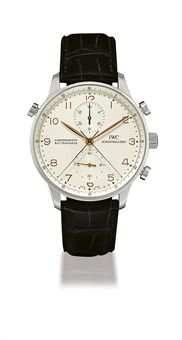
Generally, there are three major types of chronographs today, namely single pusher, flyback and rattrapante. The single pusher uses one button on the side of the watch case to start, stop and reset the timer on each successive push.  A flyback chronograph means there is one button to start and stop the chronograph function and another button to reset the timer to zero.  A rattrapante is also known as a split-seconds or double chronograph as it consists of two chronograph seconds hands.  The first push of the first button starts both hands together, another push will stop one hand, while the other hand will continue moving.  Another push will allow the stopped hand to catch up to the moving hand.  The second button allows both seconds hands to be reset to zero.
IWC Portuguese Rattrapante

Most chronographs have the independent sweep seconds hand mounted in the center and rests vertically. There are subdials that display the minutes and running seconds. Typically the designs of chronograph watches can be said to look more sporty or utilitarian, thus inferring masculine qualities.  The size of the face usually varies from 40mm to 48mm.  Naturally many people today will suggest that the chronograph is redundant since almost all digital watches and mobile phones have a stopwatch function, but there are occasions when the chronograph is handy.  

When to Wear:
At the office, so you can count the exact amount of time it takes for your boss to lose his temper again.  At the gym to measure the time between your work-outs. When you need to time yourself swimming or running. Basically you can take your chronograph everywhere except for the most formal events and showers.

Classic Chronograph Watches: 
Omega Speedmaster Professional, Mont Blanc Nicholas Rieussec, Breitling Navitimer, Zenith El Primero, (Tag) Heuer Carrera Calibre, Rolex Cosmograph Daytona

Thursday, 16 August 2012

Basics of buying a Watch pt 2: Watch types

Below are some of the various types of watches available today.  I will describe their purpose and which situations are most suitable to wear them.

Piaget Altiplano
Dress Watch
This is the watch to wear when you dress up for formal events, hence the name of dress watch. The styling is classic, elegant and subtle.  It is characterized by a clean and simple dial, either in black or white, often with a leather strap.  Remember, the colour of your watch strap should be the same colour as your belt and shoes, otherwise it will look rather uncoordinated.  
via fashiz.tumblr.com
Quite often, the watch case is slim and not too big, often 40mm and smaller.  Note that the purpose of the dress watch is not to shout and show off, but rather serve as an accessory to complete the smart and formal look. Class and understatement is what the dress watch confers.


When to wear: With a suit when you go to court, attend weddings, funerals and formal parties. Alternatively, you can also wear it with a sports coat (similar to a suit jacket) or shirt, and smarten up a casual look.
Classic examples: Piaget Altiplano, Jaeger LeCoultre Reverso, Cartier Tank, Patek Philippe Calatrava


Diver's Watch
divers-watches.net
These watches usually have a more rugged design, with a rotating bezel surrounding the face of the watch.  The purpose of these watches originated from diving. The bezel saves divers the trouble of remembering how long they have been underwater.  It features markings of 0, 10, 20, and so forth.  The diver aligns the zero marking on the bezel to the minute hand to track the number of minutes passed underwater. 

Furthermore, if the bezel does not have a locking mechanism, it should be uni-directional (counter-clockwise), as a safety measure, in case the diver accidentally bumps the watch, in which case will increase the supposed elapsed time.  This would cause the diver to return to surface prematurely, ensuring the diver never stays underwater for too long.

In addition, the hands and markers of the watch should be luminous for situations where lighting is limited underwater. This includes the seconds hand, to show that the watch has not stopped, as many dive watches possess a mechanical movement.  As legibility is important, the face of the watch is usually 40mm and bigger, sometimes up to 48mm. Naturally they need to be water resistant of at least 100 meters, although some are resistant up to over 1000 meters.   Also, the straps are either stainless steel or rubber since the watch was intended for wear underwater.

Rolex Submariner
However, many people who wear diving watches actually do not dive, but like the rugged and sporty design or the sense of exploration and excitement associated with diving.

When to wear: With a wet-suit or swimming trunks or wear it with casual clothes such as shorts and t-shirt.  Many people also wear it with their suit to present a paradoxical image of formality and the wild, whereas others just wear it to show off and feign a persona of masculinity and adventure.
Classic Examples: Rolex Submariner, Panerai Luminor Marina, Seiko Monster, Omega Seamaster, Blancpain Fifty Fathoms

Sunday, 12 August 2012

買錶的基本知識 part1

Cartier Flying Tourbillion
最近身邊的朋友開始覺得該買隻像樣的錶,所以我就來分享買錶時該注意的基本事項。對觀念傳統的人而言,除了袖釦、領帶夾以外,男生能配戴的飾品就是手錶。

手錶最基本的功能就是報時,但現在車內配備、手機、各種公共場合都很容易獲得時間的資訊,手錶報時的重要性就減少,戴錶的象徵意義大於功能性。也就是說,配戴手錶的同時也是個人特質、生活型態與地位的展現。再者,戴錶隱約透露出你對守時的重視;而在工作場合中,看錶報時比起看手機報時顯得較嚴謹、專業。當然,如果你帶一隻Mickey Mouse或是Hello Kitty的手錶,你百分之百會被當成小朋友看。

機芯是測量、產生精確時間的裝置,也就是手錶的心臟。一般來說,根據機芯的不同將錶分為兩類:機械錶和石英錶。

機械錶
機芯是使用機械裝置來測量時間,它是透過上發條儲存動力,接著用齒輪來傳送動能至擺輪,藉由擺輪的穩定頻率均化發條的動力輸出,進而推動機芯規律的運作。另外,秒針是隨擺輪移動,擺輪搖晃的頻率越高,秒針越平滑順暢。
朗格機芯
石英錶
使用特殊設計的電池提供電流促使石英結晶體產生快速且穩定的振動頻率,接著透過晶片將此頻率放大傳輸至馬達將其轉化為動力,推動指針。
ETA 石英機芯


機械錶報時不比石英錶精準,且必須定期保養,其價格也比較高昂,但一般來說機械錶仍獲得相對好的評價。原因是機械錶的製作需要精湛的工藝技術,它所展現的美感與數百年的歷史傳承。此外,機械表若妥善照顧,使用年限達數十年,可做為傳家寶代代相傳;反之,石英錶的壽命就相對有限。因此,極具收藏價值的錶款都是機械錶。

如果你戴錶只是為了追隨當季流行時尚,石英錶會是你的首選。
如果你買錶前有做點功課,機械錶是可以適度展現你的品味與質感,又可傳家的明智選擇。